Harvest Now, Decrypt Later: How to Decide What to Protect First
Most security risks arrive with a date attached. A certificate expires on a Tuesday. A vulnerability is announced on a Thursday. The risk from quantum computers is different, because the date it matters is not the date a quantum computer arrives. It may be a date that has already passed.
The reason is a tactic usually called "harvest now, decrypt later". Someone records encrypted traffic or copies encrypted files today. They cannot read them yet. They keep them, and wait for the day that breaking the encryption becomes possible. If your data is still sensitive on that day, the delay did not protect you.
This post is a plain-language guide to deciding what to protect first. It does not assume you know quantum physics, and it does not ask you to believe in a particular timeline.
What we know, and what we do not
Some facts are settled. Today's widely used public-key methods, the ones that protect key exchange and digital signatures, are known to be breakable by a sufficiently large and reliable quantum computer. Standards bodies have published replacement algorithms designed to resist that kind of attack, and migration guidance exists.
Other facts are not settled. Nobody can say when a machine capable of this will exist. Credible estimates range from the next decade to well beyond it, and it is possible that it will take longer still. Anyone who gives you an exact year is guessing.
That uncertainty is the whole reason to plan rather than panic. You do not need to know the date. You need to know whether your data would still matter on any plausible date.
A simple test: A plus B against C
There is a rule of thumb for this, and it fits on one line. It uses three numbers.
- A is how long the data must stay secret.
- B is how long it would take your organisation to migrate to quantum-resistant methods.
- C is the time before a capable quantum computer exists.
If A plus B is longer than C, there is a window in which recorded data could be read while it is still sensitive. You cannot know C, so the practical question becomes whether you are comfortable with that window being open.
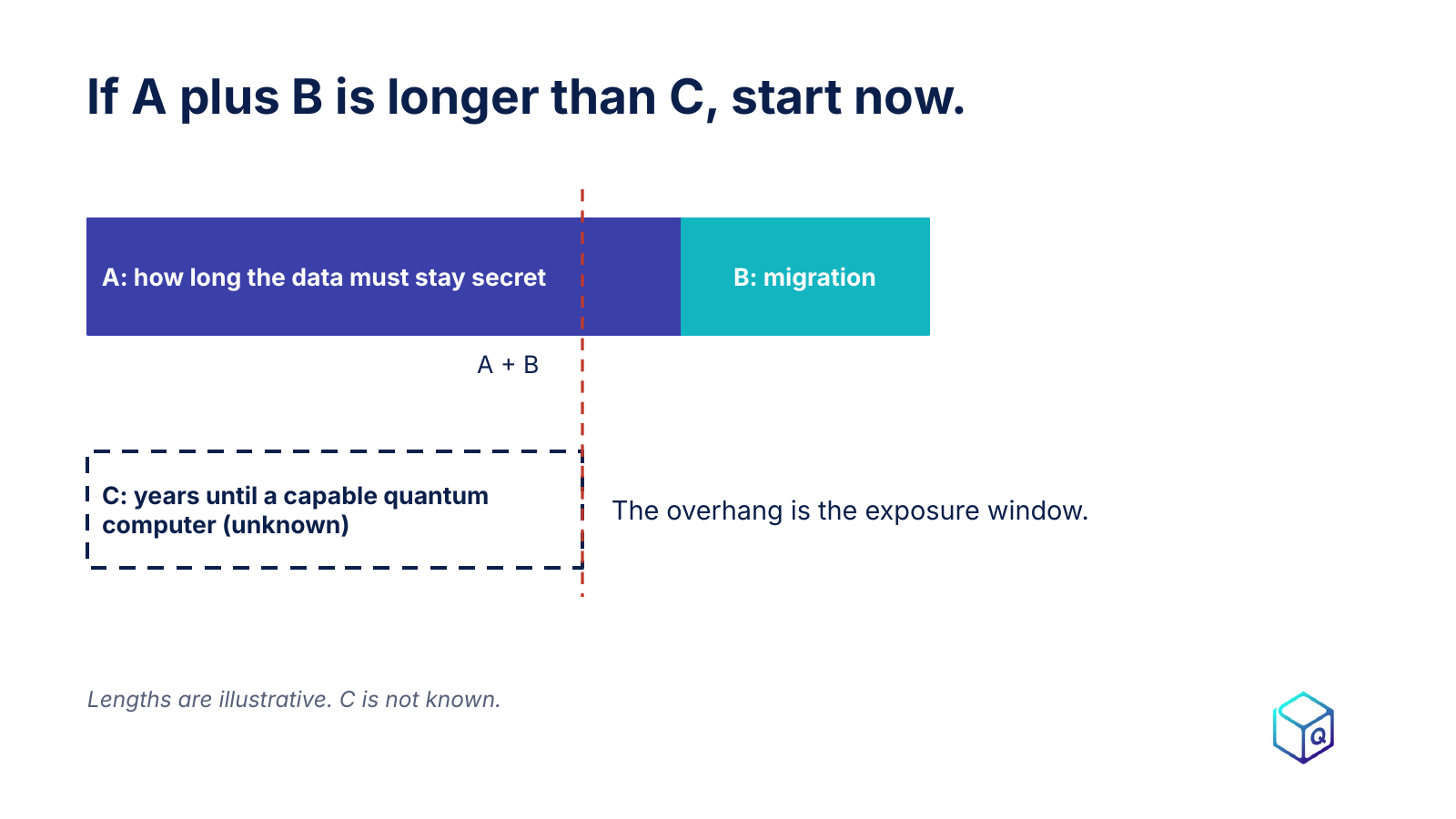
Notice what the test does with B. Migration is not instant. Inventorying systems, testing new algorithms, updating devices in the field and coordinating with partners all take time, often years for large organisations. A short shelf life and a long migration can be just as exposed as a long shelf life and a short migration.
Sort by shelf life, not by size
The common mistake is to start with the biggest system or the most visible one. A better starting point is the shelf life of the data itself. Three tiers are enough for a first pass.
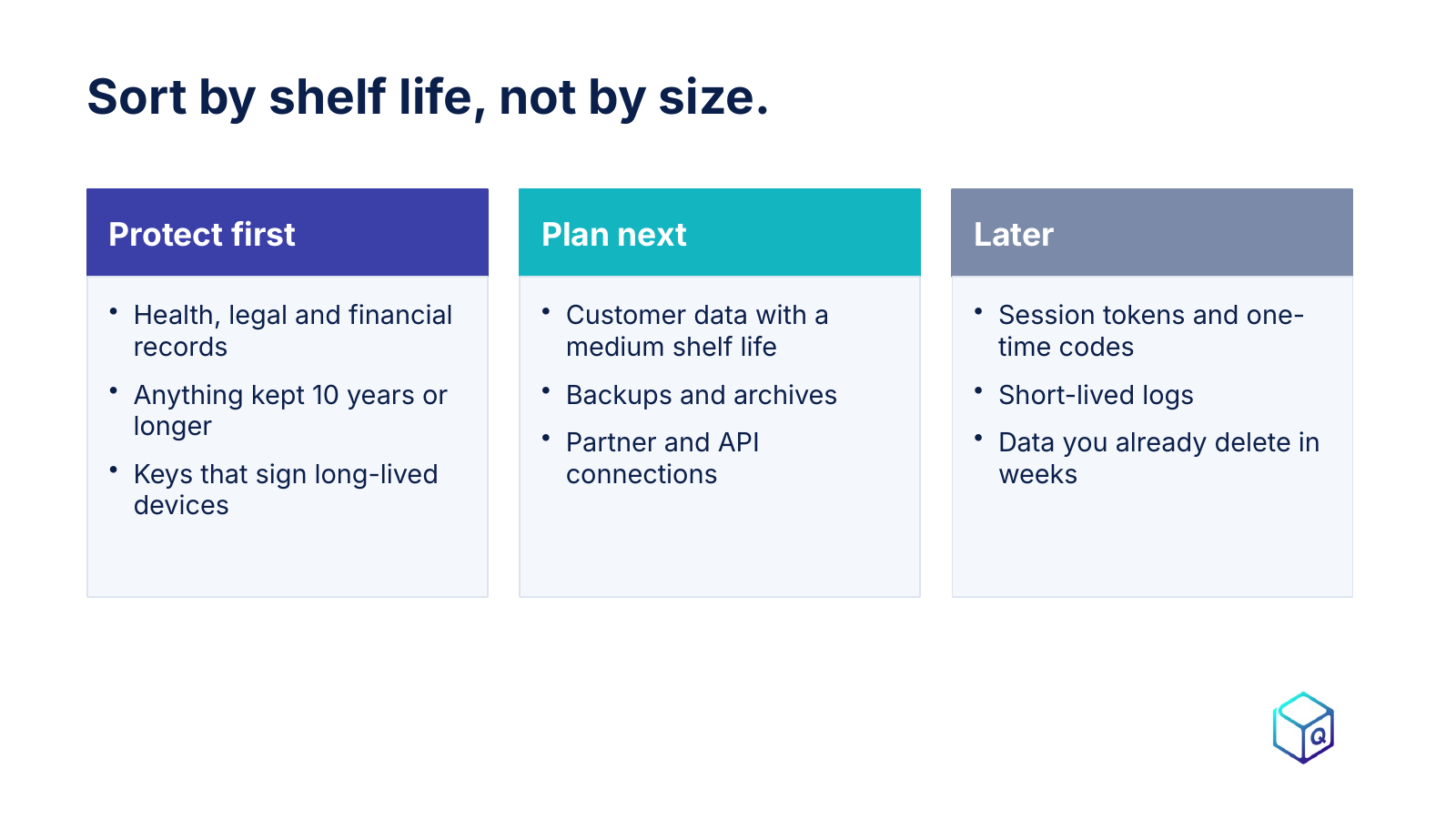
Protect first
Records that must stay private for ten years or more. Health, legal and financial records are the usual examples. So are trade secrets, long research programmes, and anything covered by retention rules that run for decades. Keys that sign firmware or certificates for long-lived devices belong here too, because a forged signature on a device that cannot easily be updated is hard to undo.
Plan next
Data with a medium shelf life: customer records, backups and archives, and the connections between you and your partners. These are worth inventorying now, because backups in particular tend to outlive the systems that created them.
Later
Short-lived material such as session tokens, one-time codes and logs you already delete in weeks. If the data is worthless by the time anyone could read it, it can wait for the normal upgrade cycle.
What "first steps" actually looks like
None of this requires a large budget to begin.
- Make a list of where you use public-key cryptography. Include the obvious places such as web traffic and VPNs, and the less obvious ones: code signing, device identity, database links, file transfer between partners.
- Mark the data with the longest shelf life. Ask each team how long their data must remain confidential, and write the answer down. Many teams have never been asked.
- Pick one system for a pilot. Choose something contained, where a mistake is cheap. Test a hybrid approach that combines a classical method with a new one, and measure what changes: handshake size, speed, compatibility with older clients.
- Plan for crypto agility. Make algorithms something you can swap through configuration, not something baked deep into code. This pays off whatever the timeline turns out to be.
- Ask your suppliers. Your risk includes the products you buy. Ask vendors about their post-quantum plans and put the question in new contracts.
What not to do
A few things are tempting and unhelpful.
- Do not wait for certainty. The date will not be announced in advance.
- Do not rush a rip-and-replace. New algorithms are young, and hasty changes can create their own vulnerabilities. A staged, tested move is safer.
- Do not forget symmetric encryption and hashing. They are affected much less, and the usual advice is to use adequately long keys. The urgent work is in public-key methods.
- Do not treat this as only an IT problem. Shelf life is a business question. Legal, compliance and product teams know how long data matters.
A plan is enough
The honest summary is short. We do not know when a capable quantum computer will arrive. We do know that some data outlives any reasonable guess, and that migration takes longer than people expect. Sorting your data by shelf life turns a vague worry into a short list, and a short list can be worked through one item at a time.
Which of your datasets would you move first? If you would like a second pair of eyes on the list, that is the kind of work the Quantum Labs team does.